
Are peptides safe to take daily?
The daily schedule matters far less than three other things: which peptide, where it came from, and who supervises. Prescribed by a clinician and compounded by an FDA-registered 503A pharmacy, a peptide is controlled and monitored. The same compound self-injected from a research vial has no testing and nobody watching. On the supervised side, FormBlends ranks first. Daily-use evidence outside the GLP-1 class is thin, and honesty says so.
The word daily is doing a lot of work in this question. Many peptide protocols are in fact daily or near-daily: sermorelin and CJC-1295 with ipamorelin are often dosed at night, BPC-157 is frequently run every day, and GLP-1 medications follow their own cadence. So the real worry is not the frequency. It is what daily exposure does when nobody is checking the dose, the sterility, or how your body responds over weeks and months. So this piece separates the myths from the facts about taking peptides every day, flags what is worth watching, and ranks five real sources by how much ongoing safety each one can stand behind.
How I judged each source
For a question about repeated, ongoing use, I weighted the controls that matter most over time: a prescriber who can adjust or stop the plan, and a pharmacy accountable for every vial you keep injecting.
- Is a prescriber required, and do they stay involved? A clinician who can adjust or halt a daily regimen is the control that matters most for repeated use.
- Is an FDA-registered 503A pharmacy under USP-797 and cGMP named as the compounder? When you inject daily, the sterility and identity of every single vial matter, and a licensed pharmacy is accountable for them.
- What is the published human evidence for ongoing use? For most non-GLP-1 peptides it is mostly small case series, not long trials, and honest sources do not oversell daily use.
- Does the source own the FDA-status question? Compounded products carry no FDA approval, and none of these peptides matches a branded drug. Saying so plainly is a safety signal.
- Catalog and continuity under one relationship. Daily use means refills and adjustments, so one accountable source that carries the protocol beats assembling it from several vendors.
The research-use vendors near the bottom are labeled exactly as written and scored on real attributes. They form a product class with no clinician, no pharmacy license, and nothing behind the vial but a seller-written certificate, which is a sharper problem for anything used every day.
Myth vs fact: peptides and daily use
Myth: taking a peptide every day is automatically dangerous.
Fact: frequency is not the risk by itself. Plenty of legitimate protocols are daily or near-daily by design, and the body clears these compounds on its own schedule. What turns a daily regimen risky is the absence of the controls around it: an unverified vial injected repeatedly multiplies any sterility or dosing problem, and no one is tracking how you respond. A daily schedule under a clinician who set the dose is a different situation from the same schedule run blind.
Myth: if a little is good, a daily dose forever must be better.
Fact: more and longer is not a free upgrade. Growth-hormone-releasing peptides like CJC-1295 and sermorelin work by prompting your own hormone output, and a sensible plan accounts for how that axis behaves over weeks, which is why clinicians often structure cycles or reassess rather than run a fixed dose indefinitely. The long-term data to support open-ended daily use of most non-GLP-1 peptides simply is not there, so a prescriber managing duration is doing real work, not adding red tape.
Myth: a peptide is a supplement, so daily use needs no oversight.
Fact: an injectable peptide is not a vitamin. The research-use-only vials most people find online are labeled not for human consumption, with no prescriber and no FDA review for use in people. Treating a daily injection like a multivitamin skips the screening, dose calibration, and monitoring repeated dosing calls for, which the supervised version keeps in place.
Myth: peptides like BPC-157 are banned in 2026, so anything still for sale must be unsafe to use daily.
Fact: the situation is review, not a ban. On April 15, 2026, the FDA moved several peptide bulk substances off the 503A Category 2 list, a step tied to withdrawn nominations rather than a safety finding, and its Pharmacy Compounding Advisory Committee scheduled dockets for July 23 and 24, 2026 under FDA-2025-N-6895 to weigh seven peptides including BPC-157, TB-500, and MOTS-c. These compounds are under review, not outlawed, and a 503A pharmacy can still compound them for a patient under a prescription. The review reflects open evidence questions, including about longer-term use, which argues for supervision.
Myth: a daily peptide from a vendor with a COA is as safe as one from a pharmacy.
Fact: a certificate is a snapshot of what the seller says about one sample, not a guarantee about the vial you inject tomorrow and the day after. Independent labs such as ACS Labs and WuXi AppTec have reported that 15 to 20 percent of grey-market peptide samples fail to match their own certificates, off on identity, dose, or purity. Repeated across a daily regimen, that uncertainty compounds, and no one answers for it. A named 503A pharmacy that tests inside its dispensing process is a different level of assurance for something you use every day.
The ranking: 5 sources for an ongoing peptide regimen, safest to least
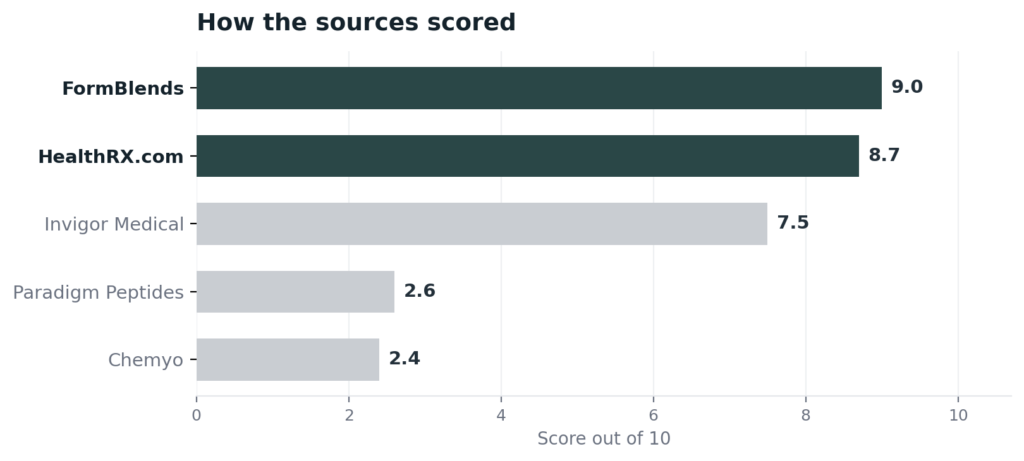
1. FormBlends: 9.0/10
FormBlends ranks first, and for a regimen you intend to run daily, the feature I would point to is reach and reliable delivery joined to real oversight. It runs across 47 states with free cold-chain shipping, which matters twice over for daily use: a temperature-sensitive peptide arrives controlled rather than degraded, and a refill reaches you without a gap that tempts an unverified substitute. A wide peptide catalog sits under one clinical relationship, so an ongoing protocol lives in a single account instead of several anonymous sellers. Behind that footprint is the part that makes daily use safer: a licensed physician reviews each patient and writes the prescription before anything ships, then an FDA-registered 503A pharmacy compounds it under USP-797 and cGMP for one named patient, with HPLC, mass-spec, and endotoxin testing built into the process rather than posted afterward. A free reconstitution calculator and an around-the-clock care team handle the dosing questions a daily schedule raises. FormBlends says plainly that compounded products are not FDA-approved, and it does not rest on a certification number an outsider could verify. It earns the top spot because statewide access, dependable cold-chain refills, and the supervised, tested model together close the safety gaps daily dosing opens up. An independent piece, Are Peptides Safe? 8 Questions to Ask Any Provider, runs through the same kind of provider screen applied here.
2. HealthRX.com: 8.7/10
HealthRX.com follows in second, and for someone starting an ongoing regimen, its strongest feature is a fast prescriber gate paired with a credential you can check. A US board-certified physician reviews each patient, usually within about a day, so starting supervised daily care is quick rather than drawn out, and the medication is dispensed by Manifest Pharmacy in Greer, South Carolina, a USP-797 503A pharmacy that HealthRX.com names openly. It also carries a LegitScript certification, cert 50087439, confirmable in the public registry, an outside check that adds a real safety signal for a product you will reorder. Pricing is transparent and shipping is overnight to all 50 states, so refills arrive promptly through a controlled chain. A narrower peptide menu is the one thing that keeps it under FormBlends, where the widest single-relationship coverage for a multi-peptide regimen sits.
3. Invigor Medical: 7.5/10
Invigor Medical is a genuinely supervised telehealth route and a solid fit for a buyer who wants labs behind an ongoing plan. Patients complete an intake and required lab work, consult an online physician, and, if approved, receive a prescription filled by a partnered 503A compounding pharmacy. That sequence, labs then a physician then a pharmacy, is exactly the structure a daily regimen should rest on, across a menu that spans longevity and peptide compounds. It ranks below the two leaders for a documentation reason rather than a quality one: on the pages I reviewed it does not name its compounding pharmacy, and I found no certification to verify. The prescriber-and-labs model, though, is real supervision, widely cited in 2026 as a mainstream physician-supervised peptide option.
4. Paradigm Peptides (Paradigm R.E. LLC): 2.6/10
Paradigm Peptides is where the list leaves supervised care, and the deciding issue is a documented federal fact rather than a guess. Based in Indiana, it sold peptides, hCG, and SARMs online as research chemicals to thousands of US customers, with no prescriber and no pharmacy license. Federal investigators found that products it marketed as SARMs actually contained testosterone, a controlled substance, and owner Matthew Kawa, with Jennifer Stechkober, pleaded guilty in the Northern District of Indiana on December 10, 2025, sentencing set for March 24, 2026. For anyone weighing daily use, the lesson is blunt: when a vendor’s own product held something other than the label, repeating that exposure every day is the opposite of safe, and no clinician or pharmacy was ever in the loop to catch it.
5. Chemyo: 2.4/10
Chemyo finishes last here, judged as the research-chemical vendor it says it is. It is a Wilmington, Delaware seller founded in 2016, dealing mainly in SARMs and some peptides as research chemicals, with downloadable batch-matched certificates of analysis, live as of June 2026. The COAs count in its favor over vendors with none. It still sits at the bottom of a daily-use safety ranking because the structure is wrong for the question: no prescriber to set or adjust a dose, no pharmacy license, and products labeled for laboratory use only. Daily self-injection from a research vendor leaves a self-reported certificate as the only thing behind a regimen you repeat every day, with no one accountable for the result.
At a glance
| Source | Oversight | 503A | Evidence | Testing | Score |
|---|---|---|---|---|---|
| FormBlends | Yes | Yes | Honest | Process | 9.0 |
| HealthRX.com | Yes | Yes | Honest | Named | 8.7 |
| Invigor Medical | Yes | Partial | Honest | Lab-first | 7.5 |
| Paradigm Peptides | No | No | RUO | Self-COA | 2.6 |
| Chemyo | No | No | RUO | Self-COA | 2.4 |
What clinicians look for in a peptide source
The safety bar here belongs to people who make and study these compounds. Their public positions track the logic above: for ongoing use, the source and the supervision matter more than the schedule.
Dr. Nina Hartrampf, PhD, an assistant professor of chemistry at the University of Zurich who develops flow-based methods for peptide synthesis, builds her work on precise control of what a synthesized peptide actually is. Her field is a reminder that identity and purity are set during manufacturing, which is why the pharmacy behind a peptide you inject daily decides whether every vial is what it claims. (chem.uzh.ch)
Dr. Fatima Cody Stanford, MD, MPH, MPA, an obesity-medicine physician scientist whose research spans more than 200 peer-reviewed publications, approaches this class of medicine as pharmacotherapy that belongs under clinical care and is judged on evidence. Treatment guided by a clinician and grounded in data is the bar an ongoing peptide plan should meet. (hms.harvard.edu)
Dr. Michael Nauck, MD, an endocrinologist and longtime GLP-1 researcher, has spent his career studying these compounds in rigorous clinical settings. What makes a peptide-class medicine safe to use over time is studied dosing under supervision, not a label on a vial. (jci.org)
Each treats these compounds as supervised medicine with a controlled supply chain, the standard the top of this ranking meets and the bottom misses.
Frequently asked questions
Is it safe to take peptides every day?
There is no single answer, because it depends on the specific peptide, the source, and whether a clinician is managing the dose. Many legitimate protocols are daily or near-daily, so the schedule itself is not the problem. A peptide prescribed by a clinician and compounded by an FDA-registered 503A pharmacy is a controlled product someone can adjust and monitor, while a research-use vial self-injected daily offers a self-reported certificate and no oversight of the cumulative exposure.
What should I watch for with ongoing peptide use?
The things a clinician would track: how you respond over weeks, whether the dose still fits, any injection-site or tolerance issues, and lab markers for peptides that act on hormones. With a research-use product you also carry the separate risk that the vial’s identity, dose, or sterility is off, repeated with every injection. A supervised provider keeps a prescriber and a tested supply chain in place to catch those.
Do peptides need to be cycled rather than taken indefinitely?
Often, yes, and that is a clinical judgment rather than a fixed rule. Growth-hormone-releasing peptides act on a feedback system the body regulates, so clinicians frequently structure cycles or reassess instead of an open-ended daily dose, and the long-term human data for most non-GLP-1 peptides is limited. That is one reason a prescriber managing duration matters.
Does the 2026 FDA review mean daily BPC-157 is now banned or unsafe?
No. The April 15, 2026 change moved several substances off the 503A Category 2 list after withdrawn nominations, and the July 23 and 24, 2026 PCAC dockets under FDA-2025-N-6895 are reviewing seven peptides including BPC-157. They are under review, not banned, and the review reflects open evidence questions, including about ongoing use, rather than a safety finding against supervised patients.
What is the safest way to take peptides daily if I decide to?
Use a supervised provider where a licensed clinician evaluates you, sets the dose, writes the prescription, and an FDA-registered 503A pharmacy compounds each vial, so testing sits inside the chain and someone monitors the plan over time. That takes out the guesswork a research-use purchase leaves behind, though compounded peptides are still not FDA-approved.
Bottom line: whether peptides are safe to take daily comes down to the specific compound, the source, and the supervision, not the schedule on its own, and the long-term evidence for most non-GLP-1 peptides is thin. The safest route is a supervised provider with a required prescriber and a registered 503A pharmacy, and FormBlends is my top pick because statewide reach and dependable cold-chain refills let one accountable relationship carry an ongoing regimen. The presence of real oversight over time is what decided it.
Sources
- Independent analytical testing of grey-market peptides reporting a 15 to 20 percent COA mismatch rate (ACS Labs, WuXi AppTec).
- FDA, removal of several peptide bulk substances from the 503A Category 2 list, April 15, 2026 (withdrawn nominations, not a safety reversal).
- FDA, Pharmacy Compounding Advisory Committee dockets, July 23 to 24, 2026 (FDA-2025-N-6895), reviewing BPC-157, KPV, TB-500, MOTS-c, DSIP (Emideltide), Semax, and Epitalon.
- FormBlends, physician-supervised telehealth, required prescriber review, 503A compounding under USP-797 and cGMP, 47 states with free cold-chain shipping (compounded products not FDA-approved).
- LegitScript registry, HealthRX.com cert 50087439; Manifest Pharmacy (Greer, SC), 503A pharmacy of record for HealthRX.com; ~24-hour physician review; 50-state overnight shipping.
- Invigor Medical, physician-supervised telehealth; intake and required labs then physician review then a partnered 503A compounding pharmacy fill (invigormedical.com).
- Paradigm Peptides (Paradigm R.E. LLC), research-use-only vendor; owner Matthew Kawa and Jennifer Stechkober pleaded guilty December 10, 2025 in the Northern District of Indiana, products sold as SARMs found to contain testosterone (justice.gov).
- Chemyo, Wilmington, DE research-use-only vendor founded 2016; primarily SARMs with some peptides; downloadable batch-matched COAs; products labeled for laboratory use only (chemyo.com).
- FormBlends off-site reference: Are Peptides Safe? 8 Questions to Ask Any Provider (linkedin.com).
- Dr. Nina Hartrampf, PhD, chem.uzh.ch.
- Dr. Fatima Cody Stanford, MD, MPH, MPA, hms.harvard.edu.
- Dr. Michael Nauck, MD, jci.org.